Signal-to-Noise Ratio (SNR): Meaning, Examples & How to Improve It
Signal-to-Noise Ratio (SNR): Meaning, Examples, and How to Apply It
The signal-to-noise ratio (often abbreviated as SNR) is a concept used in science,
engineering, and information theory to describe the relationship between meaningful information (signal)
and irrelevant interference (noise).
In modern life, the same principle applies to attention, productivity, and decision-making.
Your goals, values, and high-impact actions are the signal.
Distractions, false urgency, emotional overload, and endless input are the noise.
Improving your signal-to-noise ratio means getting clearer, acting with intention,
and protecting your focus from everything that dilutes it.
What Is the Signal-to-Noise Ratio?
In technical fields, signal-to-noise ratio measures how strong a useful signal is compared to background noise.
A higher SNR means the signal is easier to detect and the system performs better.
A lower SNR means the noise dominates, making the signal harder to recognize.
Signal vs Noise in Real Life
In daily life, the signal is what moves you forward: deep work, real learning, healthy habits, meaningful relationships,
and decisions aligned with your long-term goals. Noise is what fragments your attention: notifications, algorithmic feeds,
multitasking, perfectionism, anxiety loops, and other people’s priorities.
Signal-to-Noise Ratio in Productivity and Psychology
Many people feel “unmotivated” when the real issue is cognitive overload.
When input is constant, attention becomes fragmented and the mind stays in reaction mode.
A clarity-first approach reduces noise at the source and restores sustained focus.
How to Improve Your Signal-to-Noise Ratio
- Reduce input before output: avoid email/feeds before your first meaningful task.
- Create “signal hours”: protected deep work blocks with no notifications.
- Use friction: make distractions harder (remove apps, block sites, move phone away).
- Reward depth: attach small rewards to focused effort, not to scrolling.
- Weekly audit: ask what was signal, what was noise, and what you will remove next.
Book Resource
If you want a complete, practical system built around this concept,
explore the book The Signal-to-Noise Ratio: Why Focused Minds Win by Dan Crown.
Signal-to-Noise Ratio FAQ
What does “signal-to-noise ratio” mean?
It describes how much meaningful information (signal) exists compared to interference (noise).
A higher signal-to-noise ratio means clearer detection and better performance.
What is signal vs noise in everyday life?
Signal is what truly moves you forward: high-impact work, learning, health, and aligned decisions.
Noise is distraction, false urgency, emotional overload, and low-value input that fragments attention.
How do I increase my signal-to-noise ratio in productivity?
Reduce unnecessary input, create protected deep work blocks, remove notifications,
and build a simple system that rewards focus and reduces distraction.
Why do I feel unmotivated even when I want to succeed?
Often it is not lack of motivation but cognitive overload.
Too much noise keeps the mind in reaction mode and reduces clarity and follow-through.
Is “signal-to-noise ratio” only a technical concept?
No. While it originates in science and engineering, it also applies to attention, decision-making,
and mental clarity—because the mind also processes inputs that can be meaningful or distracting.
In an age of constant distraction, the problem is not lack of intelligence or discipline.
The problem is too much noise.
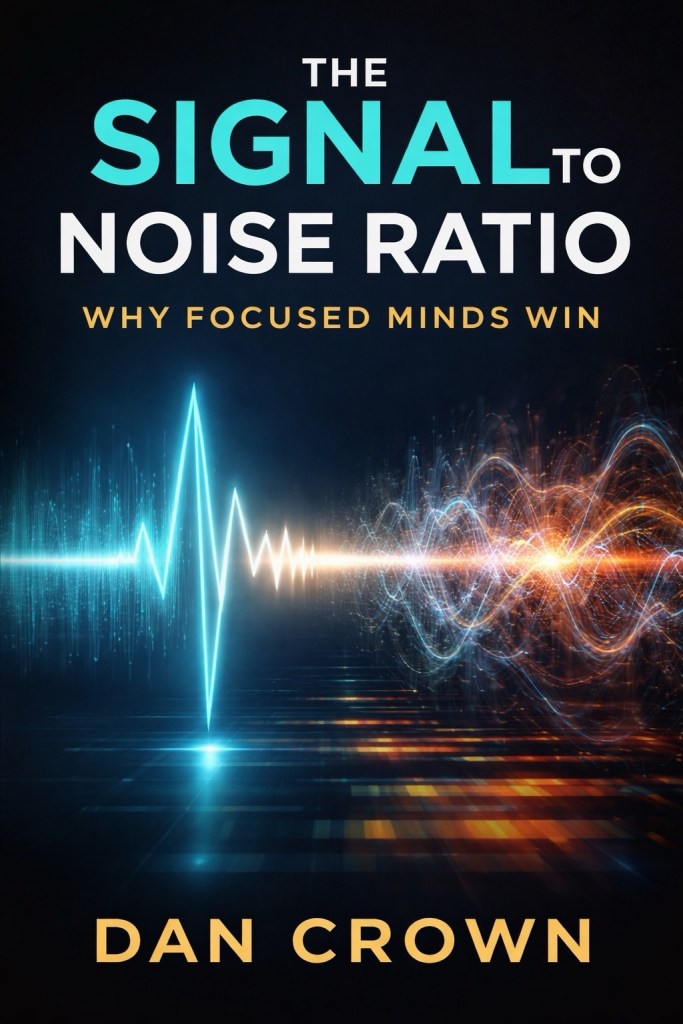
Notifications, algorithms, perfectionism, and emotional overload quietly fragment attention and drain mental energy. As a result, capable people stay busy—but rarely clear.
The Signal-to-Noise Ratio is a modern guide to clarity, focus, and mental sovereignty. It teaches one essential skill: how to distinguish what truly matters from everything that does not.

What This Book Is About
This book introduces a practical framework for filtering noise and protecting attention in a world designed to steal it.
Rather than offering motivation or rigid productivity systems, it focuses on clarity first—because focused action naturally follows clear perception.
You will learn how to:
Identify and eliminate digital, mental, and emotional noise Reclaim attention from algorithms, habits, and false urgency Build a personal signal-filtering system that works even under stress Use deep work to produce meaningful results, not superficial busyness Break the perfectionism loop that delays real progress Restore mental calm through structure, sleep, and daily clarity rituals
The result is not simply higher productivity—but a quieter mind, stronger decisions, and sustained focus.
Who This Book Is For
This book is written for:
Professionals overwhelmed by constant input and distraction Creators, thinkers, and knowledge workers seeking deep focus Readers interested in productivity, attention science, and mental clarity Anyone who feels busy but disconnected from what truly matters
Why Focused Minds Win
Focus is no longer a personality trait.
It is a competitive advantage.
Those who succeed are not necessarily more talented or more motivated.
They are simply better at filtering.
They protect their attention, reduce noise at the source, and act from clarity rather than reaction. This book shows you how to do the same—calmly, systematically, and sustainably.
Core Principle
You don’t need to do more.
You need to hear the right signal—and trust it.
Formats Available
Ebook Audiobook Paperback
 100BooksProject.com