The Fear Trap by Dan Crown
Freedom begins when fear stops making your decisions
The most effective form of control does not always use force.
Sometimes it uses silence.
Guilt.
Urgency.
Withdrawal.
Disapproval.
The fear of losing love, security, status, or belonging.
Over time, these pressures can reshape a person’s behavior until anxiety begins to make decisions on their behalf.
The Fear Trap is a book about recognizing that process—and escaping it.
Blending psychology, philosophy, behavioral insight, and practical exercises, Dan Crown explores how coercive control operates in relationships, families, workplaces, and society. More importantly, he explains how to rebuild autonomy without becoming cold, aggressive, or emotionally detached.
This is not a book about controlling others.
It is about becoming psychologically difficult to control.
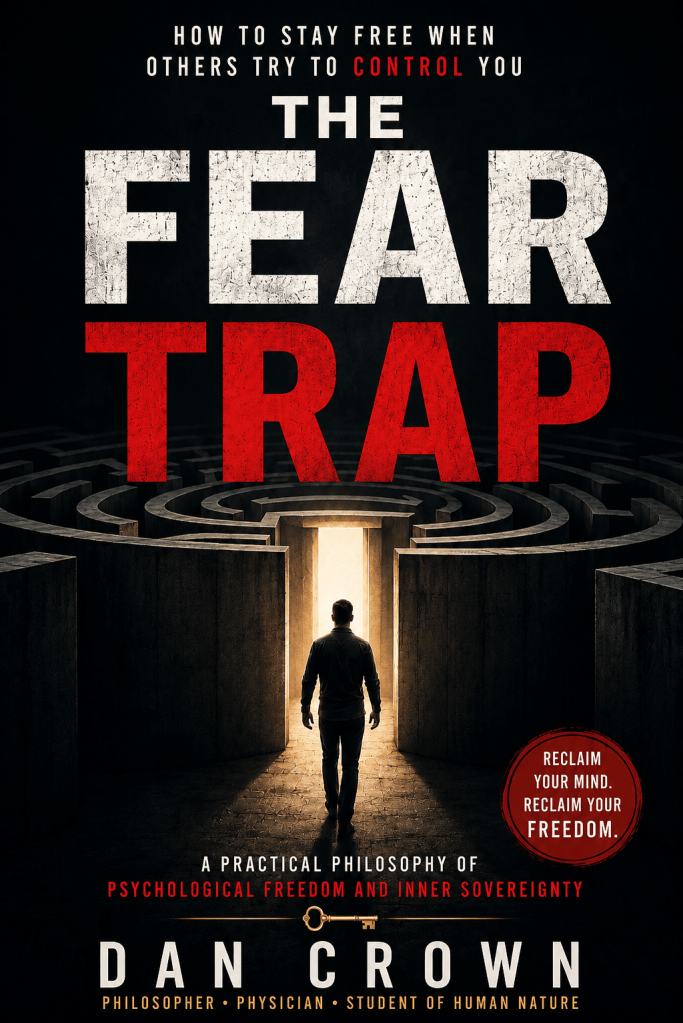
What this book explores
Inside The Fear Trap, you will discover:
- how fear becomes an invisible decision-making system;
- why intelligent and compassionate people can still be vulnerable to manipulation;
- how people-pleasing develops and gradually erodes identity;
- the connection between fear, urgency, guilt, and obedience;
- how emotional blackmail works;
- why “walking on eggshells” is a serious warning sign;
- how coercive control can appear in romantic relationships, families, workplaces, and institutions;
- how to tolerate another person’s disappointment without abandoning yourself;
- how to build calm, healthy boundaries;
- how to develop inner sovereignty and emotional resilience.
The central idea
You do not need to eliminate fear in order to become free.
You need to stop allowing fear to govern your choices.
Freedom is not the absence of fear. Freedom is refusing to let fear make your decisions.
The goal is not rebellion for its own sake.
The goal is calm neutrality:
to listen without automatically submitting,
to care without becoming emotionally captive,
to accept conflict without creating unnecessary war,
and to remain faithful to your conscience even when someone else is disappointed.
Who this book is for
This book may help you if:
- you feel controlled through guilt, silence, threats, pressure, or emotional withdrawal;
- you constantly monitor another person’s mood;
- you explain yourself excessively;
- you avoid conflict at the cost of your own identity;
- you struggle to say no;
- you feel responsible for regulating another adult’s emotions;
- you want stronger boundaries without losing empathy;
- you want to recover confidence, clarity, and autonomy.
Why this book is different
Many books describe manipulation.
The Fear Trap focuses on the internal mechanism that makes manipulation effective.
It examines the cycle:
fear → anxiety → urgency → compliance → temporary relief
Once that cycle becomes visible, it can be interrupted.
The book offers a practical philosophy for doing exactly that:
pause before reacting,
separate facts from predictions,
refuse to negotiate with panic,
accept temporary discomfort,
and choose according to conscience rather than fear.
A peace begged for is still war
Temporary peace purchased through self-betrayal is not real peace.
It is merely conflict pushed inward.
A peace begged for is still war. It is an unextinguished ember.
True peace becomes possible only when two people are free to disagree without using fear as a weapon.
Reclaim your mind. Reclaim your freedom.
You may not be able to control another person’s behavior.
You can, however, recover authority over your own decisions.
The Fear Trap is an invitation to reclaim:
your judgment,
your identity,
your boundaries,
your voice,
and your inner freedom.
Available in print and digital editions
Author: Dan Crown
Frequently Asked Questions (FAQ)
The Fear Trap: How to Stay Free When Others Try to Control You
By Dan Crown
What is The Fear Trap about?
The Fear Trap is a practical psychology and philosophy book about recognizing coercive control, emotional manipulation, and fear-based influence. It teaches readers how to build healthy boundaries, develop emotional resilience, and make decisions based on conscience rather than anxiety.
What is coercive control?
Coercive control is a pattern of psychological behaviors that gradually limits another person’s freedom. Instead of relying on physical force, it often uses fear, guilt, shame, emotional withdrawal, criticism, or control of daily life to influence decisions and behavior.
Is this book about narcissism?
Not exclusively.
Although narcissistic relationships are discussed, the book focuses on the broader psychology of manipulation. Coercive control can occur in romantic relationships, families, workplaces, friendships, organizations, and even governments.
Does the book teach people how to manipulate others?
No.
The purpose of The Fear Trap is the opposite: to help readers recognize manipulation, strengthen critical thinking, and become psychologically difficult to manipulate.
Who should read this book?
This book is for anyone who:
- feels controlled by guilt or fear;
- struggles to set boundaries;
- constantly seeks approval;
- feels responsible for other people’s emotions;
- wants greater emotional independence;
- is interested in psychology, philosophy, or personal development.
Is this book based on psychology?
Yes.
The book draws on established psychological concepts such as coercive control, emotional regulation, boundaries, people-pleasing, anxiety, cognitive patterns, and emotional manipulation, while presenting them in an accessible philosophical framework.
Is The Fear Trap a self-help book?
Yes, but it is more than that.
It combines psychology, philosophy, behavioral science, and practical exercises to help readers build long-term emotional freedom rather than offering quick motivational advice.
What is the main message of the book?
The central idea is simple:
Freedom is not the absence of fear. Freedom is refusing to let fear make your decisions.
What will I learn?
You will learn how to:
- recognize coercive control;
- identify emotional blackmail;
- stop people-pleasing;
- tolerate another person’s disappointment;
- develop healthy boundaries;
- think clearly under emotional pressure;
- separate facts from fear-driven predictions;
- strengthen your inner sovereignty.
Is this book only about romantic relationships?
No.
Romantic relationships are one application, but the principles also apply to:
- family dynamics;
- parenting;
- friendships;
- workplace relationships;
- leadership;
- politics and propaganda;
- everyday social interactions.
What is “walking on eggshells”?
Walking on eggshells describes the experience of constantly monitoring another person’s emotions to avoid conflict. It is often an early warning sign that fear has begun replacing authentic communication.
What is emotional blackmail?
Emotional blackmail occurs when someone uses fear, guilt, obligation, disappointment, or emotional withdrawal to pressure another person into compliance.
What is the difference between healthy influence and manipulation?
Healthy influence respects your freedom to disagree.
Manipulation attempts to remove that freedom by creating psychological pressure.
What is inner sovereignty?
Inner sovereignty is the ability to make decisions according to your own conscience instead of fear, guilt, urgency, or the need for approval.
Does the book contain practical exercises?
Yes.
Each section includes practical mental models, reflective questions, and exercises designed to help readers recognize manipulation and strengthen psychological independence.
Is this book suitable for therapists and coaches?
Yes.
Mental health professionals, coaches, educators, leaders, and anyone interested in human behavior may find the book useful as a practical framework for discussing boundaries, autonomy, and emotional resilience.
What makes The Fear Trap different?
Unlike many books that focus only on toxic personalities or abusive relationships, The Fear Trap explores the internal psychology that allows manipulation to succeed. Its focus is not merely on identifying controllers, but on building a mind that cannot be easily controlled.
Is this book anti-relationship?
Absolutely not.
Healthy relationships require empathy, respect, vulnerability, and mutual freedom. The book argues that genuine love cannot flourish where fear becomes the primary means of influence.
What is the ultimate goal of The Fear Trap?
To help readers become calmer, freer, and more psychologically resilient by replacing fear-driven reactions with thoughtful, value-based decisions.
Key Topics
- Coercive Control
- Psychological Manipulation
- Emotional Abuse
- Emotional Blackmail
- Healthy Boundaries
- People-Pleasing
- Anxiety
- Fear Psychology
- Psychological Freedom
- Emotional Resilience
- Inner Sovereignty
- Personal Growth
- Practical Philosophy
- Relationship Psychology
- Self-Leadership
- Critical Thinking
- Decision-Making
- Personal Responsibility
- Self-Confidence
- Authentic Living

