Soulfield Theory – Consciousness, Free Will & the Structure of Reality | 100BooksProject.com
100BooksProject
Dan Anghel · 100BooksProject.com
Soulfield
Theory
A New Philosophical Framework for Consciousness, Free Will, and the Structure of Reality
What is consciousness — and where does it come from?
Get the PaperbackRead the Dialogue
Explore
The Problem
“The transition from neural processes to conscious experience — the feeling of seeing, thinking, or choosing — remains unexplained.”
Despite extraordinary advances in neuroscience, physics, and artificial intelligence, the nature of subjective experience remains deeply mysterious. Modern science can map brain activity with remarkable precision, yet the hard problem of consciousness persists: why do physical processes give rise to inner experience at all?
Soulfield Theory proposes a new conceptual framework for approaching this problem. Rather than assuming consciousness is merely a by-product of neural complexity, the theory explores the possibility that conscious experience reflects a deeper causal structure of reality. In this view, the human brain functions not simply as a generator of consciousness but as a biological interface through which conscious agents interact with the physical world.
At the center of this framework lies a key philosophical concept: self-determining causation — a third possibility beyond the deterministic and the random, one in which a system originates action from within itself rather than merely transmitting prior causes.
✦
Implications
If conscious agents truly possess the capacity to originate action, then the universe cannot be understood as a purely mechanical chain of causes. Reality may include layers of causation capable of generating agency, intention, and experience.
The goal of this work is not merely to propose answers but to open a deeper investigation into the nature of consciousness and the foundations of reality — because the question of consciousness is ultimately inseparable from the question of what kind of universe we inhabit.
Topics Explored
01
Consciousness and the hard problem of experience
02
The relationship between brain and mind
03
The philosophical foundations of free will
04
The limits of artificial intelligence and machine consciousness
05
Self-determining causation and agency
06
The metaphysics of mind and reality
07
Philosophical implications for science, ethics, and human meaning
Disciplines in Dialogue
Philosophy of MindTheoretical PhysicsNeuroscienceMetaphysicsArtificial Intelligence
“Is consciousness merely an emergent property of matter, or is it a fundamental aspect of reality itself?”
✦
Now Available
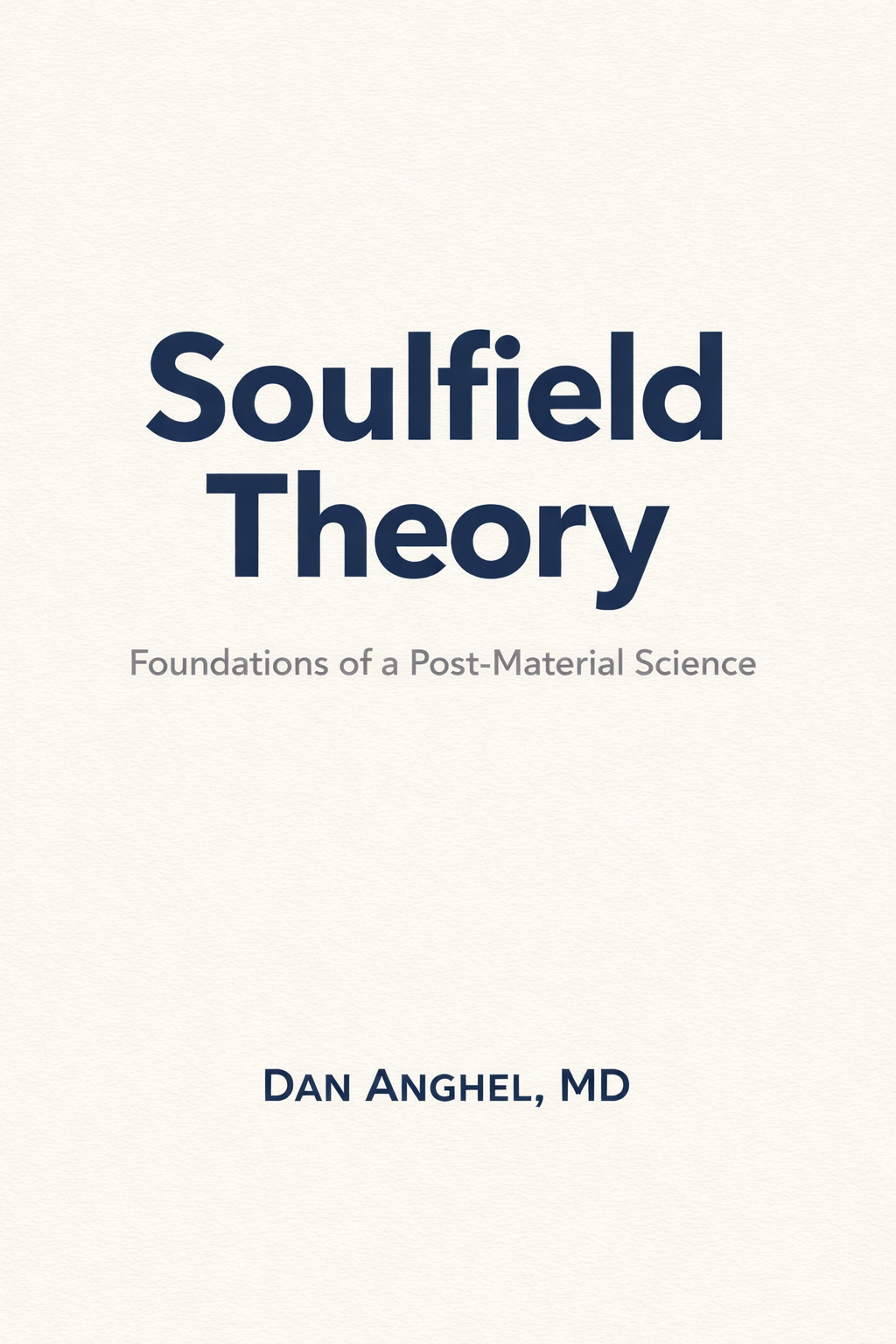
Soulfield Theory: Foundations of a Post-Material Science
The complete philosophical exploration of consciousness, agency, and the deeper structure of reality. Available in paperback through Lulu Press.Order Paperback
Philosophical Dialogue
Questions & Answers on Soulfield Theory<div class="qa-item"> <button class="qa-question" onclick="toggleQA(this)"> <span class="qa-num">01</span> <span class="qa-q-text">What is Soulfield Theory?</span> <span class="qa-icon">+</span> </button> <div class="qa-answer"> <div class="qa-philosopher"><div class="qa-speaker">Philosopher</div><p>Your work proposes something called Soulfield Theory. What exactly is this theory?</p></div> <div class="qa-author"><div class="qa-speaker">Author</div> <p>Soulfield Theory is a philosophical framework that attempts to explain consciousness and agency in terms of a deeper causal structure of reality.</p> <p>The theory begins with a simple observation: modern science can describe physical processes with extraordinary precision, yet it still cannot explain why certain physical systems are accompanied by subjective experience.</p> <p>Soulfield Theory proposes that conscious agents are not produced by the brain. Instead, the brain functions as a biological interface through which conscious agents interact with the physical world.</p> </div> </div> </div> <div class="qa-item"> <button class="qa-question" onclick="toggleQA(this)"> <span class="qa-num">02</span> <span class="qa-q-text">Why do you believe the brain does not generate consciousness?</span> <span class="qa-icon">+</span> </button> <div class="qa-answer"> <div class="qa-philosopher"><div class="qa-speaker">Philosopher</div><p>Many neuroscientists believe consciousness is produced by neural activity. Why do you disagree?</p></div> <div class="qa-author"><div class="qa-speaker">Author</div> <p>Neuroscience has made remarkable progress in identifying correlations between brain states and conscious experiences. However, correlation is not explanation.</p> <p>We can observe neural activity associated with seeing the color red, but this does not explain why that neural activity should produce the experience of redness. This gap between physical processes and subjective experience is often called the explanatory gap.</p> <p>Soulfield Theory suggests that this gap exists because consciousness is not produced by physical processes alone.</p> </div> </div> </div> <div class="qa-item"> <button class="qa-question" onclick="toggleQA(this)"> <span class="qa-num">03</span> <span class="qa-q-text">What role does the brain play in your theory?</span> <span class="qa-icon">+</span> </button> <div class="qa-answer"> <div class="qa-philosopher"><div class="qa-speaker">Philosopher</div><p>If the brain does not produce consciousness, what role does it play?</p></div> <div class="qa-author"><div class="qa-speaker">Author</div> <p>The brain functions as an interface system. Just as a computer interface allows a user to interact with a machine, the brain allows a conscious agent to interact with the physical world.</p> <p>In this framework, neural processes translate between physical events and the intentions or experiences of the conscious agent.</p> </div> </div> </div> <div class="qa-item"> <button class="qa-question" onclick="toggleQA(this)"> <span class="qa-num">04</span> <span class="qa-q-text">What is "self-determining causation"?</span> <span class="qa-icon">+</span> </button> <div class="qa-answer"> <div class="qa-philosopher"><div class="qa-speaker">Philosopher</div><p>You use the term "self-determination" frequently. What does it mean?</p></div> <div class="qa-author"><div class="qa-speaker">Author</div> <p>Most physical systems fall into two categories: deterministic systems, where every state follows necessarily from previous states, and random systems, where outcomes are governed by probability.</p> <p>However, neither determinism nor randomness can explain genuine agency. Self-determining causation refers to the capacity of a system to originate action from within itself, rather than merely transmitting prior causes. This capacity is what allows conscious agents to initiate actions.</p> </div> </div> </div> <div class="qa-item"> <button class="qa-question" onclick="toggleQA(this)"> <span class="qa-num">05</span> <span class="qa-q-text">Why can't randomness produce free will?</span> <span class="qa-icon">+</span> </button> <div class="qa-answer"> <div class="qa-philosopher"><div class="qa-speaker">Philosopher</div><p>Some philosophers argue that quantum randomness might allow free will. Why do you reject this idea?</p></div> <div class="qa-author"><div class="qa-speaker">Author</div> <p>Randomness introduces unpredictability, but unpredictability is not the same as agency. If an action occurs randomly, it is not truly chosen by the agent.</p> <p>Therefore randomness cannot account for free will any more than strict determinism can. Genuine agency requires a third possibility: self-originating causation.</p> </div> </div> </div> <div class="qa-item"> <button class="qa-question" onclick="toggleQA(this)"> <span class="qa-num">06</span> <span class="qa-q-text">How does your theory differ from traditional dualism?</span> <span class="qa-icon">+</span> </button> <div class="qa-answer"> <div class="qa-philosopher"><div class="qa-speaker">Philosopher</div><p>Your ideas sound similar to dualism. Are they the same?</p></div> <div class="qa-author"><div class="qa-speaker">Author</div> <p>Traditional dualism proposes that mind and matter are fundamentally different substances. Soulfield Theory focuses instead on causal structure.</p> <p>Rather than simply asserting two kinds of substance, it proposes a form of causation capable of originating action. The emphasis is not on metaphysical separation but on the logic of causation itself.</p> </div> </div> </div> <div class="qa-item"> <button class="qa-question" onclick="toggleQA(this)"> <span class="qa-num">07</span> <span class="qa-q-text">Could artificial intelligence ever become conscious?</span> <span class="qa-icon">+</span> </button> <div class="qa-answer"> <div class="qa-philosopher"><div class="qa-speaker">Philosopher</div><p>Given your framework, could a sufficiently advanced artificial intelligence become conscious?</p></div> <div class="qa-author"><div class="qa-speaker">Author</div> <p>Artificial systems can simulate intelligence extremely well. They can process information, recognize patterns, and generate complex responses. However, these processes remain fundamentally algorithmic.</p> <p>Algorithmic systems propagate causal chains defined by prior rules. Consciousness requires the ability to originate causation, which algorithmic systems do not possess.</p> </div> </div> </div> <div class="qa-item"> <button class="qa-question" onclick="toggleQA(this)"> <span class="qa-num">08</span> <span class="qa-q-text">Does this mean machines will never be conscious?</span> <span class="qa-icon">+</span> </button> <div class="qa-answer"> <div class="qa-philosopher"><div class="qa-speaker">Philosopher</div><p>So you believe artificial consciousness is impossible?</p></div> <div class="qa-author"><div class="qa-speaker">Author</div> <p>Artificial consciousness is impossible. Consciousness requires a soul. Consciousness is a gift from God.</p> </div> </div> </div> <div class="qa-item"> <button class="qa-question" onclick="toggleQA(this)"> <span class="qa-num">09</span> <span class="qa-q-text">How does Soulfield Theory relate to evolution?</span> <span class="qa-icon">+</span> </button> <div class="qa-answer"> <div class="qa-philosopher"><div class="qa-speaker">Philosopher</div><p>How does your theory fit with evolutionary biology?</p></div> <div class="qa-author"><div class="qa-speaker">Author</div> <p>Evolution explains the development of increasingly complex biological systems. In this framework, evolution may have produced organisms capable of serving as increasingly sophisticated interfaces for conscious agency.</p> <p>The theory does not reject evolution but suggests that evolution describes the development of the interface rather than the origin of consciousness itself.</p> </div> </div> </div> <div class="qa-item"> <button class="qa-question" onclick="toggleQA(this)"> <span class="qa-num">10</span> <span class="qa-q-text">Does your theory support the existence of free will?</span> <span class="qa-icon">+</span> </button> <div class="qa-answer"> <div class="qa-philosopher"><div class="qa-speaker">Philosopher</div><p>What are the implications of your theory for free will?</p></div> <div class="qa-author"><div class="qa-speaker">Author</div> <p>If conscious agents possess the capacity to originate causation, then free will is not an illusion. Instead, it becomes a fundamental feature of reality.</p> <p>Human actions would not simply be the outcome of deterministic chains or random fluctuations but the expression of genuine agency.</p> </div> </div> </div> <div class="qa-item"> <button class="qa-question" onclick="toggleQA(this)"> <span class="qa-num">11</span> <span class="qa-q-text">Does Soulfield Theory imply the existence of God?</span> <span class="qa-icon">+</span> </button> <div class="qa-answer"> <div class="qa-philosopher"><div class="qa-speaker">Philosopher</div><p>Do your ideas lead to a theological conclusion?</p></div> <div class="qa-author"><div class="qa-speaker">Author</div> <p>The theory does not begin with theology. It begins with the analysis of causation and the nature of conscious agency.</p> <p>However, if individual agents possess limited self-originating causation, one may ask whether reality ultimately requires a deeper source of such causation. Philosophically, this question touches on ideas traditionally associated with the concept of God.</p> </div> </div> </div> <div class="qa-item"> <button class="qa-question" onclick="toggleQA(this)"> <span class="qa-num">12</span> <span class="qa-q-text">Why does this theory matter?</span> <span class="qa-icon">+</span> </button> <div class="qa-answer"> <div class="qa-philosopher"><div class="qa-speaker">Philosopher</div><p>Why should anyone care about these questions?</p></div> <div class="qa-author"><div class="qa-speaker">Author</div> <p>Because the nature of consciousness determines how we understand ourselves and our place in the universe.</p> <p>If consciousness is merely a by-product of physical processes, then human agency and freedom may be illusions. But if consciousness reflects a deeper structure of reality, then the universe is not simply mechanical. It is a reality capable of experience, intention, and meaning.</p> </div> </div> </div>
Final Reflection
Soulfield Theory proposes that consciousness cannot be reduced to computation, physical complexity, or neural activity alone. Instead, consciousness may reflect a deeper causal structure of reality — one in which agents are capable of originating action and interacting with the physical world through biological systems.Order the Book100BooksProject.com
 100BooksProject.com